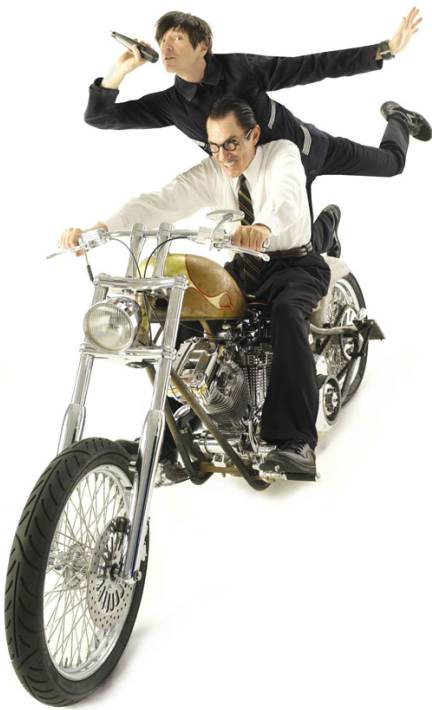
The enduring, eternally
resurrecting art that spills from (the one, the only) Sparks, L.A.'s kings
of the cleverest of pop, is something to behold: The sibling pair has, for
30-odd years, defined and continually redefined its audacious brand of
ultradramatic (in a funny sort of way), progressive and wickedly wordy pop
music. It has tickled our brains, dictated fist pumps and made us go
"woooo."
In fact,
Sparks have been on a roll over the past half-decade, offering a spate of critical
and semicommercial successes that started to flow copiously with the
release of the extraordinary, revolutionary Lil' Beethoven in 2004. A curiously powerful and radical
restructuring of rock into a drum-free world of elaborately layered vocals
and keyboards in rhythmic, almost looplike modes, the record spun out
harmonized –– and hilarious –– tales of angry young bands and ugly guys with
beautiful girls. Lil' Beethoven changed the very shape of the rock song, showed us how it potentially could
continue to evolve while continuing to, well, rock.
The 2006
follow-up, Hello Young Lovers,
further explores this smearing of rock theatricality with facetiously
operatic drama. Still relatively drum-lite, Lovers emphasizes elaborate arrangements and thematically
linked parts where Russell's repetitive vocal laments are used as the
primary rhythmic elements, amid Ron's lush orchestral-string synths floated
above.
Sparks'
newest one is called Exotic Creatures of the Deep, and takes the process of rock even further,
deconstructing 13 new songs of enormous grace, style, wit and elan (such as
"Lighten Up, Morrissey").
Says Ron
over coffee at a cafe on Melrose, "We thought we were making a new start
with Lil' Beethoven, and we kind of
didn't know how far we could go with that general direction. But we still
feel that we haven't run out of ideas in that general way. It's kind of
thinking of songs in a different way than we have. We always wrote songs,
and even though they were a little bit eccentric, they were still songs.
With Lil' Beethoven, we
started working in a more musical way, and hoping we could concentrate them
into something that had some kind of form that could be seen as a song."
In my
notes on the new album are scribbled the words form and structure, because it is quite amazing what Sparks have
been achieving in these new pieces: They're pop songs, but they're not –– or
at least they're much, much more. They're breaking boundaries regarding the
protraction and mutation of songs. How far can they take it before we
concede that they're actually writing symphonies? These are radical
statements –– but that doesn't seem to worry them.
"Because
we work in such isolation," says Ron, "we never know what the reaction is
gonna be to what we're doing; and the critical reaction to Lil'
Beethoven was so strong, and the
reaction to our shows was so strong, it was stirring to us and pushed us to
take it further than we had before."
Even as
the relentlessly good-humored creators of such supremely intelligent quirky-pop
–– from the rocking over-the-top theatrics of albums such as Kimono My
House (featuring "This Town Ain't Big
Enough for the Both of Us") and Propaganda in the early '70s to their KROQ-friendly '80s
sets like Whomp That Sucker
and Angst In My Pants ––
Sparks made with Lil' Beethoven
a substantial leap that heralded the beginning of a new phase.
"We felt
it, too," says Russell. "It was a conscious attempt to shake it up within
our own sphere. You know, when you have that many albums [21, but who's counting?],
the easiest route is just to keep more of the same thing going, 'cause you
have enough people that just like what you're doing.
"But at
that point –– I guess it was 18 albums that we had done –– you just say,
What's the point? But if you just push yourself, you're capable of doing
bigger, more expansive, more intricate things. We had written at that point
almost an album's worth of songs that would have been the Lil' Beethoven album, but we just thought, God, boring."
That'd
be boring for us listeners, too. And as Russell points out: "What the heck
did Sparks have to lose, anyway? It's not like it's Mariah Carey, where
they're going to let down the entire EMI organization, or whoever she works
for."
"Our
thing," Russell continues, "has always been the whole spirit of pop music:
rebellion, and sort of provocation –– but it can be in nonsloganeering ways,
not provocative in an 'off the establishment' kind of way, but just
musically, and doing things that people have gotta go, 'Whoa, what is that?'"
And if
it's loads of heavy drums and bass and guitars you think you need to truly
rock yourself into bliss, listen to the new album's method of discarding
standard instrumentation and shape without losing an ounce of in-yo-face
rock belligerence.
Says
Russell, "We try to figure out ways to replace those things so we can do
that with stacked up voices, aggressive strings. There's other ways it can
still have the spirit of rock music at its aggressive best, but also be
done in another way."
Indeed,
as Ron keenly observes, "When we first started out, we were kind of forcing
drums and guitars to play songs that weren't natural for drums and guitars;
but I think as time went on, we got brainwashed in a way to 4/4 structures.
So this was a way to free ourselves up in the same way we kinda felt free
at the very beginning, where it isn't sort of a natural fit for a band to
be doing what we're doing. And that's the way we like it, where there is a
forced feeing to the arrangement."
And Sparks
do all this without much regard to fans' expectations. Russell: "That's one
thing that we almost try to not play
to, the 'What would the Sparks audience want?' When you do that, you get
into a trap of saying, 'Well, this is what's expected, even within Sparks'
world.' Hopefully, Sparks' audience is gonna go with us where we go because
that's the nature of what we do. Taking risks and doing things in
unexpected ways has always been there with Sparks."